Our favourite season is here, and the plants are in full swing; knowing how to apply fertilisers in spring is very important, and at Eiviss Garden we’re here to advise you.
Our plants and spring
Plants grow best when they receive the optimal amount of sunlight, adequate amounts of water and plenty of essential nutrients for healthy growth and the production of flowers and fruit. For optimal growth, we need to know how and when to fertilise them.
Fertilisers provide the nutrients plants need to grow, bloom and maintain healthy foliage, produce more fruit, establish a strong root system and help combat disease and insect pressure. Plants benefit most from fertiliser applications when they are at their peak of growth, and spring is one of those times.
Types of fertiliser
The best time to fertilise is when many plants are coming out of dormancy. In spring, deciduous plants begin to bud, the buds on flowering plants start to burst, stems and branches lengthen, and new roots form. Nutrients will support all of this growth, so as a rule of thumb, an annual fertiliser application is recommended in early spring.
There are several types of fertiliser:
Slow-release granular fertilisers.
Liquid feeds applied to the soil as a drench
Foliar sprays
Fertiliser spikes.
Furthermore, using natural fertilisers such as compost can add nutrients to your soil.
Compost
Compost is decomposed organic material made from other plant matter and animal waste from livestock that are mainly fed on plants. These include chickens, cows and horses.
Compost can also be made from waste such as grass clippings and fallen leaves in your garden, as well as kitchen waste like ground coffee, eggshells and fruit and vegetable peelings. Worm castings and mushroom compost are two additional options that will add nutrients to your soil.
Individual needs
Plants may have individual needs when it comes to fertilisers. Acid-loving plants such as azaleas, blueberries, camellias, hydrangeas and rhododendrons prefer soil with a more acidic pH to absorb the optimum nutrients. Flowering plants need more phosphorus to help encourage stronger development of buds, fruit and flowers.
Vegetables benefit from and require more frequent fertiliser applications during the season because they are producing. Slow-release fertilisers can be incorporated at planting time for a prolonged release of nutrients. Side-dress with calcium nitrate at the first and third fruit set. Additionally, some growers use liquid fertilisers every two weeks.
Indoor potted plants can be fertilised with a liquid plant feed for most varieties. Do this once each season in spring, summer and autumn, but skip winter for plants that go dormant. Regardless of the plants you are trying to feed, timing is important.
Applying fertiliser in the wrong season can cause new, tender growth that may be damaged, especially if applied in cold weather in late autumn or winter. Therefore, it is best to stop fertilising during dormant periods. Also, in areas that may be at risk of late frosts, it is best to wait until mid-spring. Everyone could benefit from putting fertiliser application schedules in their calendars.
How do you apply fertilisers in spring?
Avoid fertilising new plants until they are fully established, as it can cause an increase in new tender growth that can make the plant weak and leggy.
Always follow the rates and application methods recommended by the manufacturer.
Fertilise outdoor plants at the coolest part of the day, especially in summer.
Always water fertilisers in thoroughly to distribute nutrients throughout the soil profile and prevent scorch.
Finally, avoid over-fertilising and carry out soil tests annually to see what nutrients your plants need.
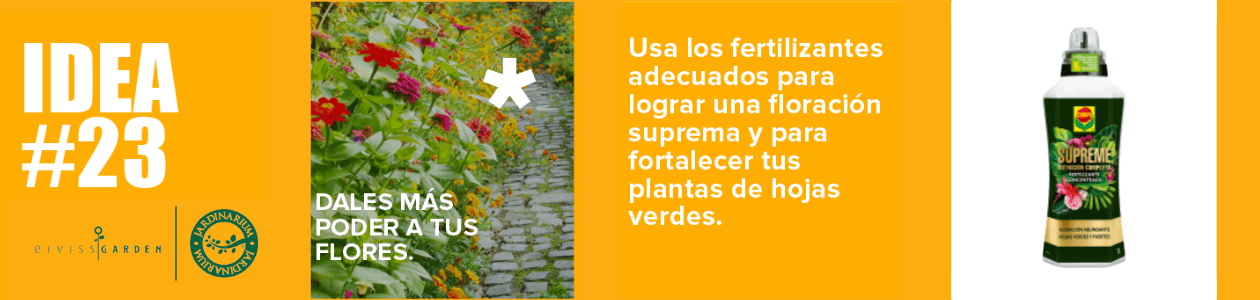
For the care of your plants at Eiviss Garden, we recommend COMPO Supreme Fertiliser, which you can buy in our Garden Centre and florists. It is a universal liquid fertiliser suitable for all types of plants thanks to its nutrient combination. With magnesium, calcium and iron for healthy, vigorous growth. Optimal flowering and intensely green leaves. Rapid recovery from nutrient deficiencies. Ideal formulation for all types of green and flowering plants. Twice the yield of a conventional fertiliser: enough for 300L of irrigation water.
Now you know how to apply fertilisers in spring, but if you still have questions, don't hesitate to come to our Garden Centre or florists and we'll advise you.
Tags
Garden
,
eco garden
,
sustainability
Click to share on Facebook (Opens in a new window)
Click to share on Twitter (Opens in a new window)
Click to share on Pinterest (Opens in a new window)
Click to share on Tumblr (Opens in a new window)